Securing access at every level.
Security in Microsoft environments is built on identity as the foundation, with Microsoft Entra ID controlling how users, administrators, applications, and services authenticate and access resources. Entra enforces consistent access boundaries through strong authentication, role‑based access, and least‑privilege principles across cloud, hybrid, and SaaS environments.
Microsoft Defender, Sentinel, and Purview extend this foundation by protecting identities and workloads, detecting and responding to threats, and governing sensitive data wherever it resides. Together, these platforms deliver an integrated security model that connects access control, threat protection, security operations, and data governance into a unified, scalable Microsoft security strategy.
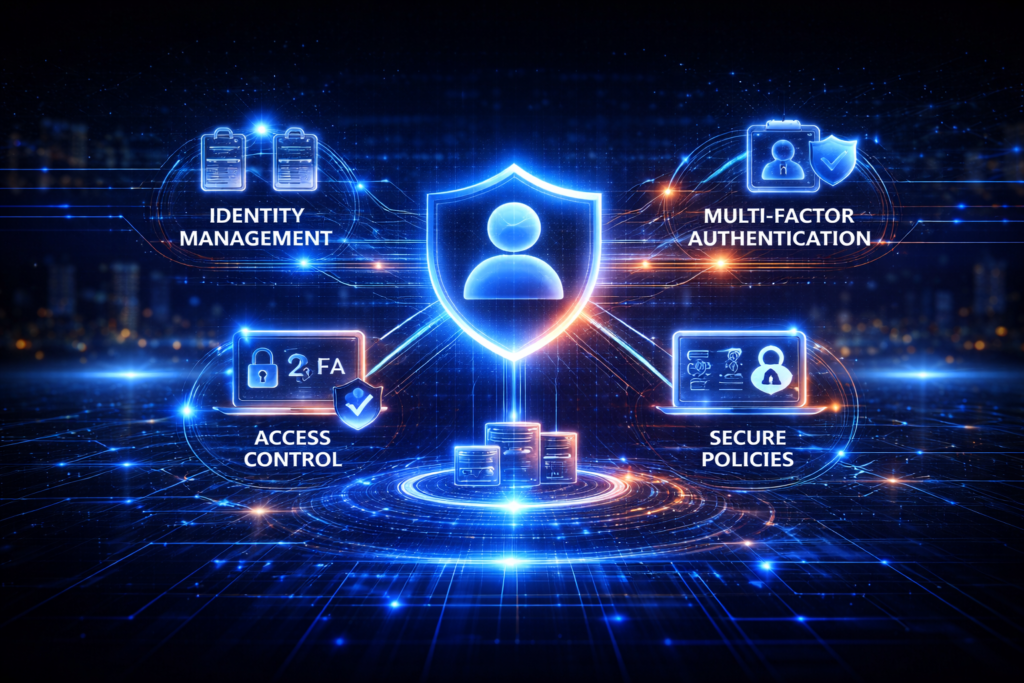
Security has shifted from protecting infrastructure to protecting identities, data, and access across cloud, SaaS, and hybrid environments. As organizations rely more heavily on Microsoft platforms, security controls must be consistent, integrated, and scalable rather than fragmented across individual tools or teams. A unified approach ensures access decisions, threat detection, and data protection work together instead of operating in silos.
By aligning identity, threat protection, security operations, and data governance, organizations can reduce risk while still enabling the business to move forward. This approach helps prevent security gaps, improves response to incidents, and ensures security investments directly support business resilience, compliance, and trust.
In Microsoft environments, access to applications, data, and infrastructure is primarily controlled through identity rather than network location, making identity protection and access governance the most critical security control.
Modern attacks rarely target a single layer, requiring coordinated visibility and protection across Microsoft Entra, Defender, Sentinel, and Purview to effectively detect and respond to incidents.
Aggregating security signals into a unified platform enables faster investigation, clearer context, and more consistent response to threats before they escalate into business‑impacting incidents.
As sensitive data moves across cloud and SaaS platforms, organizations need clear visibility and governance to ensure data is properly classified, accessed, and protected in line with regulatory and internal policies.
Microsoft‑aligned security controls allow organizations to enable cloud adoption, remote work, and AI services while maintaining strong protection, consistent governance, and operational efficiency.
We evaluate your identity and access management across Microsoft Entra ID and Active Directory, focusing on enterprise access models that support secure, scalable access across users, applications, and administrators. Our assessment emphasizes Zero Trust principles and least‑privilege access using role‑based access control (RBAC), Conditional Access, and Privileged Identity Management (PIM), ensuring privileged access is controlled, auditable, and aligned with operational and security requirements as the environment scales.
We design and implement identity and access management solutions centered on Microsoft Entra ID and Active Directory, establishing a secure and scalable enterprise access model aligned with Zero Trust principles. This includes architecting hybrid identity, defining role‑based access models, and implementing authentication and authorization strategies using Conditional Access, multi‑factor authentication, and Privileged Identity Management (PIM).
Application security in Microsoft environments focuses on reducing risk across cloud workloads and SaaS applications through integrated posture management and runtime protection. Microsoft Defender for Cloud delivers Cloud Security Posture Management (CSPM) and workload protection to identify misconfigurations, vulnerabilities, and threats across virtual machines, containers, databases, and cloud services. Microsoft Defender for Cloud Apps adds CASB capabilities, providing visibility into SaaS usage, OAuth apps, and third‑party integrations, while enforcing controls to protect applications and the data they access across cloud and SaaS environments.
Cloud and IT infrastructure security in Microsoft environments focuses on protecting on‑premises and hybrid systems using consistent, identity‑driven controls. Microsoft Entra ID and Microsoft Defender for Cloud extend security visibility and protection across servers, networks, and workloads, while integrating with enterprise controls such as Cisco TACACS+ for network device administration and centralized database authentication and authorization. This approach enables organizations to reduce configuration risk, strengthen access control, and maintain secure, resilient infrastructure as they modernize at their own pace.
Artificial intelligence security in Microsoft environments focuses on ensuring AI services such as Microsoft Copilot and Azure AI Foundry operate within established identity, data, and security boundaries. Microsoft Entra governs who can access and use AI capabilities, while Microsoft Purview enforces data classification, protection, and compliance controls to prevent oversharing or misuse of sensitive information. When integrated with Microsoft Defender and Sentinel, organizations gain visibility into AI usage, access patterns, and potential risks, enabling secure adoption of AI services while maintaining control, governance, and trust across enterprise environments.
Security monitoring and threat detection in Microsoft environments relies on continuous visibility and identity‑driven control. Microsoft Sentinel centralizes security signals across identities, endpoints, workloads, and applications to detect, investigate, and respond to threats in real time, while Microsoft Entra Conditional Access proactively reduces risk by enforcing policy‑based access decisions using user context, device state, and sign‑in risk. Together, these capabilities enable organizations to detect suspicious activity early, limit attack impact, and respond consistently across cloud and hybrid environments.


Jason is a seasoned IT advisor with over 15 years of relevant intercsots in industry,, Including strategic guidance on cloud computing, cybersecurity, and IT infrastructure. His helbed he collaboratively support enterprise clients to provide effective and ar biliently; Al-driven solutions to address complex technical challenges problems across various industries.